Construction ERP Bid Management: From Estimate to Signed Contract

If your estimating process still lives in email threads, shared drives, and a collection of “final.xlsx” files, you are not alone. Most contractors and field service teams build bids in whatever tools are nearby, because getting the proposal out the door feels like the only thing that matters.
The problem shows up later. Version confusion, slow approvals, and messy handoffs quietly turn into margin loss, delayed job setup, and unreliable forecasts.
That is where construction ERP bid management makes a difference. Instead of treating estimating and proposals as a separate world from operations and accounting, an ERP helps you manage the entire bid-to-contract process in one system, from first takeoff to signed contract and job kickoff.
Why Bid Management Breaks Down Without an ERP
The hidden cost of spreadsheet estimating
Spreadsheets are flexible, but they are not designed for the pace and complexity of construction bidding. When bids ramp up, teams start copying old files, pasting pricing from emails, and collecting scope notes in multiple places.
That approach creates three predictable outcomes:
- It becomes hard to confirm which scope, pricing, and alternates are current.
- Approvals and markups get stuck in inboxes.
- Estimators and operations staff lose time re-entering information during job setup.
You might still win work, but the process often depends on a few key people who “know where things are.” That is not a system. It is a risk.
Why version control becomes a profit risk
In bid management, version control is not a nice-to-have. It affects how you price, what you promise, and what the team builds.
If a last-minute change order request, value engineering adjustment, or scope clarification is captured in an email but not reflected everywhere else, the proposal can drift away from reality. Then the signed contract becomes the starting point for rework instead of execution.
With an ERP-supported workflow, you can treat scope and pricing like controlled documents. You reduce “side conversations” that never make it back into the estimate.
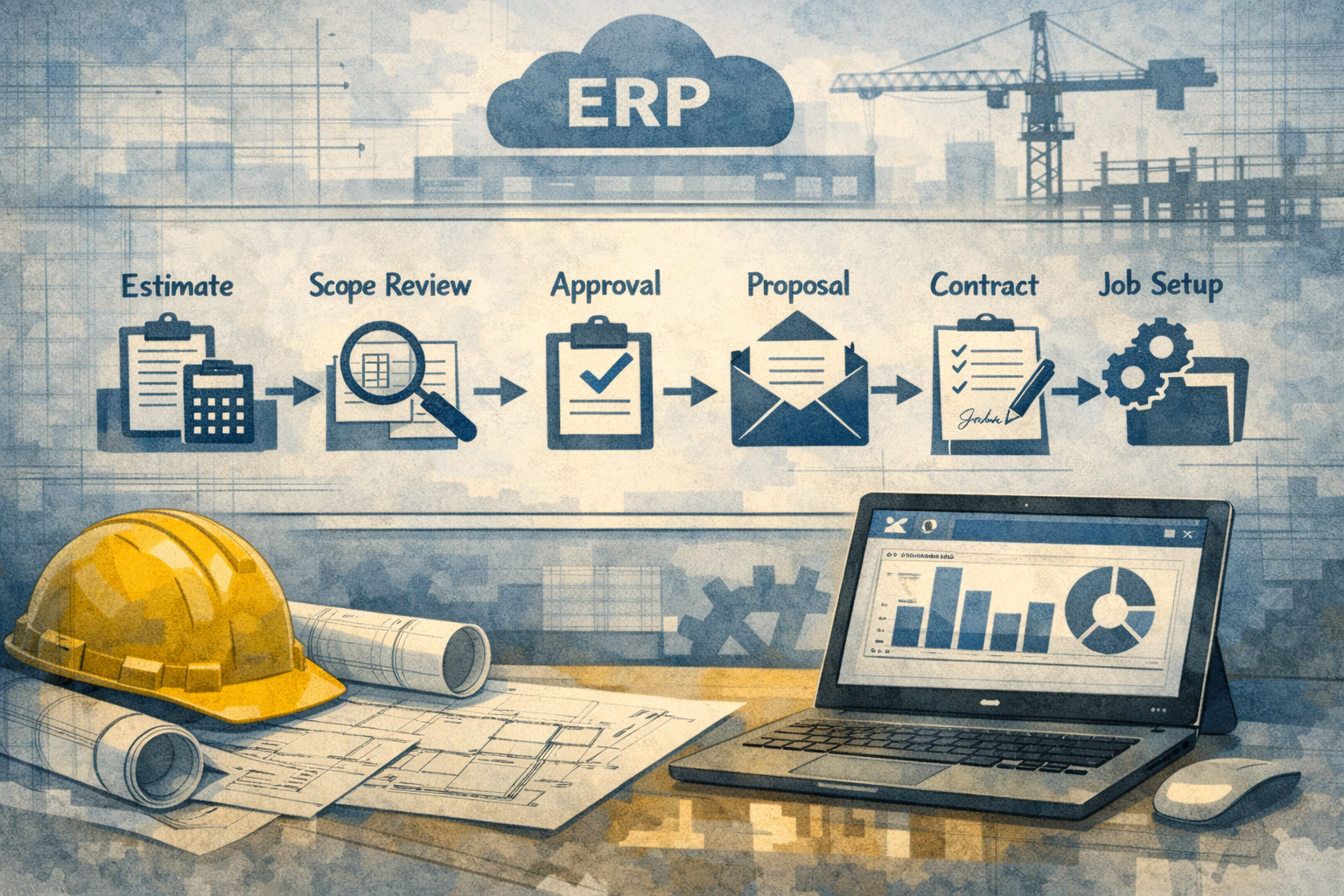
What “Bid-to-Contract” Looks Like in a Construction ERP
Standardizing the estimate and scope package
A construction-focused ERP does not replace every estimating tool in the world, but it can serve as the single source of truth that connects the work.
A strong bid-to-contract workflow in an ERP typically includes a consistent estimate structure that mirrors how you manage budgets and cost codes, a scope package that is easy to review and approve internally, and a proposal format that reduces manual formatting and errors.
This is one of the biggest benefits of working with an implementation partner. The goal is not to make your business fit a generic template. The goal is to build a repeatable system that still reflects how you sell and deliver projects.
Keeping approvals and changes auditable
Approvals often stall because leadership needs context, and the request arrives as an attachment with no history. When approvals live in disconnected tools, it is hard to answer simple questions like:
“What changed since the last review?”
In an ERP workflow, approvals can be tied to the underlying estimate, scope, and pricing assumptions. That creates an audit trail that helps teams move faster without skipping steps.
It also matters when a bid is handed off. If you can see what was approved and why, the job starts with clarity.
Turning a Winning Bid Into a Job Without Rework
Job setup, budgets, and cost codes flow forward
The handoff from estimate to job setup is where many teams lose momentum. After the award, someone has to rebuild budgets, cost codes, and billing schedules so accounting and project management can do their work.
When the estimate structure is aligned with job costing, a construction ERP helps reduce duplicate entry. Instead of rewriting the same numbers into a new system, your team can move key information forward into the job record.
The result is simple but powerful: the job starts faster, with fewer mistakes, and with better cost visibility from day one.
Cleaner handoffs between ops, accounting, and the field
Bid management is not only an estimating function. It is the beginning of delivery.
When the award is final, operations needs the scope and schedule assumptions. Accounting needs the billing structure and cost codes. Field teams need clarity on what is included and what is excluded.
An ERP workflow supports those handoffs by making information visible to the right roles without turning every question into a meeting. That visibility also reduces “shadow tracking,” where each team builds its own spreadsheet because the official system is not trusted.

Pipeline Visibility: Forecasting Workload and Win Rates
Understanding your bid funnel in real time
Most contractors want to answer two questions every month:
“How much work are we likely to win?”
“Do we have the capacity to deliver it?”
If bids are tracked in scattered tools, pipeline reporting becomes manual. It also becomes subjective. Someone has to decide whether an opportunity is “real,” whether it should be weighted, and whether it is still active.
With construction ERP bid management, bid activity can be structured in a way that supports reporting. Over time, that structure helps you see patterns in win rates by client type, project size, or service line.
For commercial contractors, this visibility becomes especially important when multiple job sites compete for the same crews and subcontractors.
Capacity planning that does not depend on guesswork
Forecasting is not only about revenue. It is about staffing, scheduling, and avoiding the “feast or famine” cycle.
When you can see your pipeline clearly, you can make earlier decisions about hiring, subcontractor commitments, and equipment planning. You can also prevent the common scenario where teams chase every bid, because they cannot tell which opportunities are most likely to convert.
The goal is not perfect forecasting. The goal is better decisions with better data, delivered earlier.
Getting Started With ERP Bid Management (Practical Next Steps)
What to map before you configure
Before you configure any system, map the workflow you want to run. In most cases, that includes:
- How an opportunity is created and qualified.
- Where estimate versions are stored and how they are approved.
- How scope changes are captured.
- How a winning bid turns into a job, budget, and billing plan.
- Which metrics leadership needs to see weekly and monthly.
This is where many teams realize the real bottleneck is not software. It is inconsistent process. The right ERP configuration supports the process, but it cannot replace it.
How DC Tech Group supports implementation
ERP success is less about “turning it on” and more about implementing it with the right structure and support.
DC Tech Group helps construction and field service businesses centralize estimating, approvals, proposals, and job setup within Acumatica. For organizations that need a reliable path from estimate to signed contract, implementation and migration services can make the difference between an ERP that sits unused and one that becomes your operational backbone.
If you want to talk through your current bid-to-contract workflow and see what a cleaner, faster process could look like in Acumatica, contact DC Tech Group.